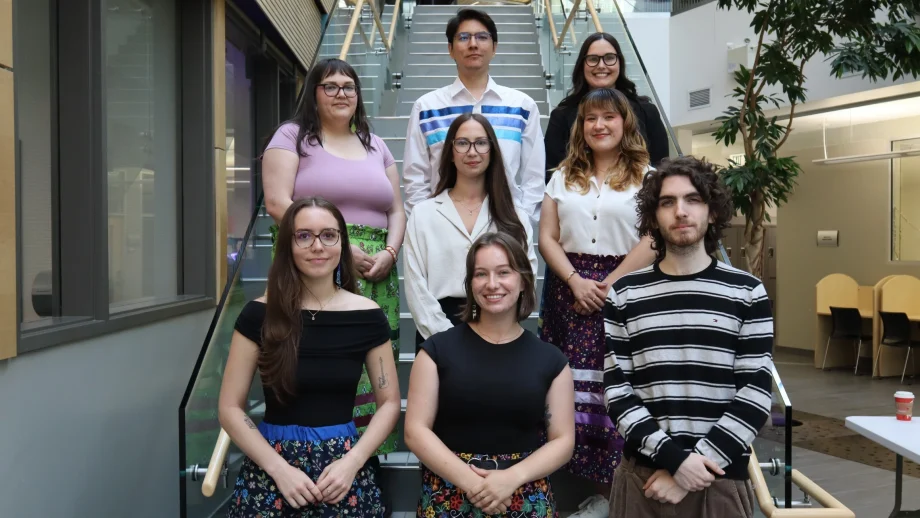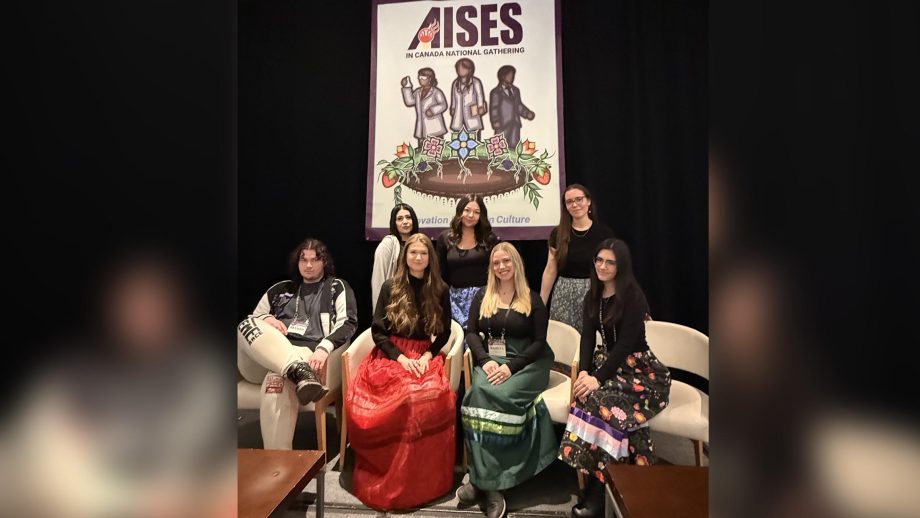

This past summer, UWinnipeg celebrated 10 years of the Indigenous Summer Scholars Program (ISSP), a 12-week program which gives undergrad students the opportunity to explore the academic career and possibilities of graduate studies through Indigenous research.
Since 2017, over 115 scholars have completed ISSP, leading to a wide range of careers including graduate studies and continued research that originated in the program. UWinnipeg caught up with four past graduates who shared how participating in ISSP impacted their journey and where they are today.
Anna Neil (BA 17, BEd 17, MA 24)
When I attended the Indigenous Summer Scholars Program (ISSP), I was a young Anishinaabe mother raising my newborn son while trying to find my place at the university. There were moments when the weight of parenting, finances, and school felt overwhelming, but ISSP reminded me that I belonged there. It gave me more than academic support. It gave me confidence, community, meaningful mentorship, and the courage to dream beyond what I thought was possible.
The program helped me recognize that Indigenous knowledge, our stories, and our ways of knowing are not only valuable, but essential within higher education. It strengthened my confidence to pursue a path rooted in my culture, my community, and the teachings of my Elders.
ISSP reminded me that I belonged at UWinnipeg.
Anna Neil
Today, I have completed my Bachelor of Arts, Bachelor of Education, and Master of Arts in Indigenous Governance, and I am beginning my PhD at the University of Manitoba. Along the way, I have taught at the University of Winnipeg, conducted Indigenous-led research, spoken on Indigenous food sovereignty, and worked alongside Elders, Knowledge Keepers, students, and communities to advance Indigenous education, research, and self-determination.
Everything I do is rooted in my identity as an Anishinaabe kwe. I carry my ancestors with me, and I carry the responsibility of creating better pathways for the generations coming after us. My success has never been mine alone. It belongs to my children, my family, my community, and every person who believed in me when I was still finding my own voice.
Looking back, ISSP was one of the first places that helped me believe I could become the woman I am today. I hope my journey reminds other Indigenous students that they belong in these spaces. Our voices matter, our knowledge is powerful, and our success creates opportunities for those who will follow.
Anna Neil is currently pursuing her PhD in Natural Resources and Environmental Management at the University of Manitoba.
Leena Tetreault (BSc 26)
Participating in the ISSP has had a major and lasting impact on both my academic and personal life. Over the two summers, I had the opportunity to work independently, collaborate with other scholars, and learn alongside supportive professors. I was introduced to new laboratory techniques, data analysis methods, and areas of science that deepened my understanding of research.
One aspect I valued most was building relationships with professors and learning from their experiences. As the first person in my family to attend university, many aspects of academia were unfamiliar and, at times, intimidating. Applying for grants, presenting at conferences, and conducting research were all new experiences. I feel incredibly fortunate to have had mentors through ISSP who were always willing to answer my questions, guide me through challenges, and encourage me to believe in my abilities. Their support helped me become more confident in academic spaces.
ISSP also had a meaningful impact on me personally. Through cultural workshops, learning from the ISSP Elder, and connecting with other Indigenous scholars, I learned more about culture and community while becoming more confident in expressing my identity in academic spaces. These experiences showed me that my culture is not separate from my academic journey but can be an important part of it.
The skills, relationships, and teachings I gained through ISSP have stayed with me throughout my undergraduate degree and research, and I will continue to carry them with me throughout medical school and into my career as a physician.
Leena is currently enrolled at the University of Manitoba Doctor of Medicine (MD) program.
Taylor Boucher (BA 22, MA 26)
Participating in the Indigenous Summer Scholars Program (ISSP) was one of the first steps I took toward connecting to a broader Indigenous network. As an undergraduate student who did not yet have a strong cultural identity, entering ISSP was transformative. It connected me to like-minded peers, Indigenous mentors, and scholars who were also aiming for graduate education, each with their own unique connection to their Indigenous identity.
The program played a pivotal role in developing my academic and professional skills while simultaneously supporting my personal growth and identity. The impact of these connections has been enduring. Since completing ISSP, I have earned my Master of Arts degree, worked within the Indigenous nonprofit sector, and now contribute to an Indigenous organization at a national level.
I wouldn’t be where I am today without the foundation built through ISSP.
Taylor Boucher
I wouldn’t be where I am today without the foundation built through ISSP. This includes not only the incredible Indigenous staff, students, and mentors, but also the network of non-Indigenous staff whose unwavering support has guided my journey every step of the way. I couldn’t thank them more for their help.
Taylor is currently working as a Junior Policy Analyst with the Assembly of Manitoba Chiefs.
Tara Faye Myran (BA4 19, MDP 22)
Overall, my university experience at the University of Winnipeg was great!
While I was working towards attaining my undergraduate degrees, I had the opportunity to participate in the ISSP program. This innovative program allowed me to get an in-depth experience of research. For this program I had participated in the research project titled Indigenous Doulas for First Nations Women who travel for Birth. This learning enhanced my knowledge of mental health issues and outcomes for Indigenous women throughout pregnancy. This was of particular interest to me as my paternal great grandmother had been a midwife/doula when she returned from World War 2 in my community of Long Plain First Nation.
This program equipped me with the skills, and confidence that encouraged me to further my education into the Masters of Development Practice (MDP) Program in 2020. The MDP program went on to provide me with the foundation and equipped me with the tools, skills, and knowledge I needed to become a qualitative researcher.
I am grateful that I chose University of Winnipeg as my school.
Tara Faye Myran
Additionally, accessing the Indigenous Student Services Centre supports and resources helped me flourish in a number of ways and I am grateful that I chose University of Winnipeg as my school.
Currently, I am working towards my PhD in the College of Community and Global Health at the University of Manitoba and employed by the College of Physicians and Surgeons of Manitoba as Director of the Restorative Practices Program and the Knowledge Translation and Mobilization Specialist.
My undergrad prepared me for theory.
My Masters implemented theory.
My PhD allows me to create theory.
Overall, my work with the College of Physicians and Surgeons of Manitoba is giving me the strength and courage to share lived experiences and amplify my voice and make meaningful and impactful change within the health care system.
Tara is currently pursuing her PhD in the College of Community and Global Health at the University of Manitoba. She is also working as the Director of Restorative Practices Program and a Knowledge Translation and Mobilization Specialist with the College of Physicians and Surgeons of Manitoba.