A proud UWinnipeg alum, of Métis and settler descent, Justin Rodger (BA 10, BBA 09) is driven by a desire to reclaim cultural traditions, and rebuild community links between Métis, First Nations, and Canadians through purposeful economics. He is dedicated to understanding the historical pathways of his ancestors and exploring their relationship to the broad history of how western Canada came to be on native land.
A strong advocate for education and lifelong learning, Justin approaches every topic with curiosity and care. “I like to know about issues before I speak on them,” he said, explaining his philosophy which shines through on his extensive knowledge of Métis history.
“I am a patriot for Manitoba. Real reconciliation isn’t performative, it’s fundamental. It’s where everyone economically contributes and benefits, in order that tomorrow’s Manitoba is better than yesterday’s.”
Real reconciliation isn’t performative, it’s fundamental.
Justin Rodger
Justin’s journey with cultural reclamation started when he began asking the details of why we called certain people Métis. He wanted to learn things hidden from him. “The unknown details of history are just eternally fascinating to me.”
Tracing his family roots was straightforward up to his grandparents; his Métis heritage connects directly to his grandfather on his mother’s side.
“My Papère fiddled and had a trap line for decades,” reflects Justin, noting that these skills were not passed down the generations. Even though there were bits and pieces of the culture present during family gatherings, many traditions faded over time. “We all jigged as kids. But in the absence of tangible community, it was much harder to maintain these traditions.”
To begin with his research, he asked his extended family for stories of the past, but as the family moved around from Richer, St. Anne, Pine Falls, Winnipeg, and out to Alberta and BC, it became hard to trace. From there, Justin sought community in online Métis and broader Indigenous spaces to learn more.
Tracing his ancestry
Justin has been able to trace his Métis ancestors six generations back to the fur trade and the tribes involved with The Northwest Company and Hudson Bay Company. His ancestors settled in the Red River area before the settlement was founded in 1811 by Lord Selkirk.
The first settlers were Jean Baptiste Lagimodiere, a North West Company voyageur, and his Québecois wife Marie Anne Gaboury. They are the French grandparents of Louis Riel and Justin’s fifth great-grandparents. This connection to the Riel family makes Louis Riel Justin’s first cousin four times removed and Julie Riel (Louis’ mother), who is commemorated by the Ecole Julie Riel School in the Louis Riel School Division, a great-aunt four times removed.
Other notable ancestors include Pierre Falcon (for whom Falcon Lake on the Manitoba-Ontario border is named), Thomas August Harrison, who sat on the 1879 Provisional, and Amable Nault, a carpenter who worked on many notable structures including the Grey Nuns Convent, now known as the Saint Boniface Museum.
This family lineage is just a fraction of what Justin has been able to uncover. Despite these discoveries and knowledge of ancestry, it wasn’t until the formal recognition of the Métis people by the crown in 2016 Supreme Court of Canada Daniels vs. Canada decision that Justin obtained his Manitoba Métis Federation (MMF) citizenship and started getting actively involved in community.
I think personally I didn’t like the feeling of being Indigenous but not being acknowledged by the Crown of Canada.
Justin Rodger
“I think personally I didn’t like the feeling of being Indigenous but not being acknowledged by the Crown of Canada,” said Justin. “It’s challenging growing up in that grey zone as someone without Indian Act status, without reserves, without recognition.” The landmark ruling affirmed Justin’s confidence to proudly represent his heritage and build meaningful relationships with other Indigenous entrepreneurs and governments.
Merging heritage with entrepreneurship
Today, Justin serves as president of JRS Industrial and Power Solutions, an original equipment manufacturer (OEM) of medium-voltage grid equipment. In Manitoba, JRS has played a critical role in major infrastructure projects, including Manitoba Hydro’s Keewatinok Substation (Bipole III) and the Riel Convertor Station. Additional projects include the complex substations and switchgear systems for mining companies such as Vale and Hudbay Minerals Inc.
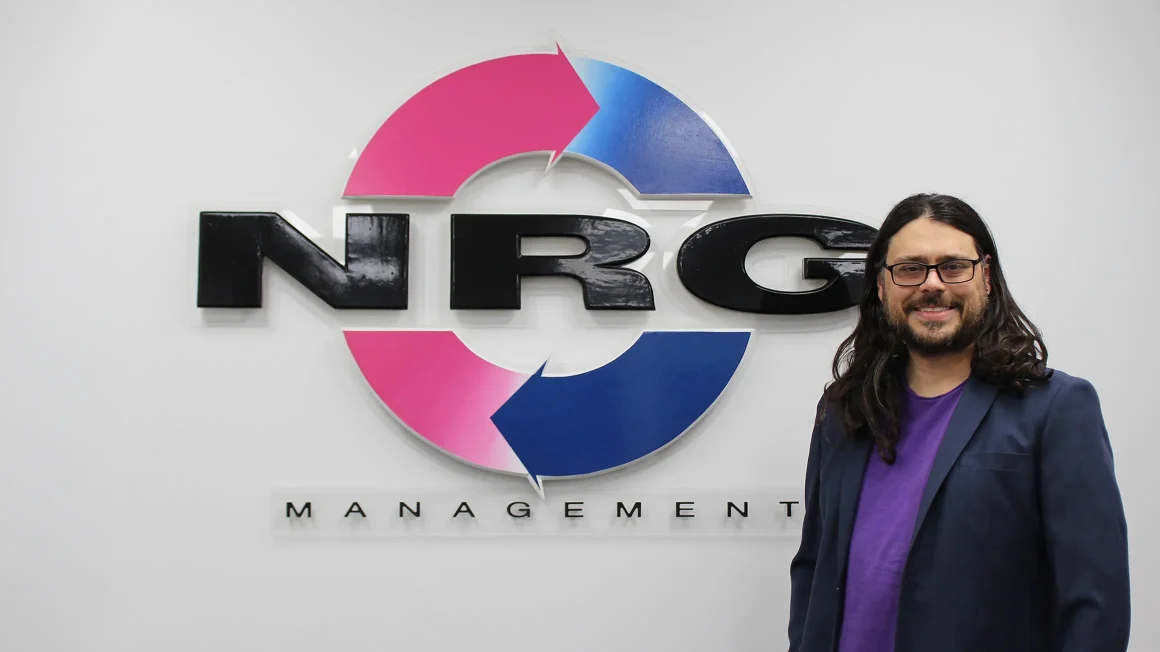
Justin also serves as the vice president of NRG Management, a full-service mechanical, electrical, HVAC, industrial process contractor and service company founded by his parents 30 years ago. Guided by his vision and powered by the collaboration of dozens of dedicated team members, NRG Management has experienced remarkable growth.
Among the recent high-profile projects are the Treaty 1 Development Corporation’s Oodena Gas and Convenience Station on Kenaston Boulevard, the RRC Polytech Stevenson Aviation & Aerospace Training Centre, and major upgrades for the New Flyer Industries electric bus lines.
In 2022-2023 NRG Management was the general contractor for the deep energy retrofit project at the MMF home office, which saw major upgrades to the building on Henry Street. These upgrades included the mechanical, plumbing and electrical systems as well as installation of solar air and Photovoltaic (PV) systems. All work was completed by NRG in house trades teams, and a group of 18 local companies working on the project; 15 of whom were Métis owned.
The growth of NRG reflects a commitment to the community. Justin says he is proud to support local economics and Indigenous entrepreneurs by providing energy efficiency solutions that align with sustainability and respect for the land, waters, and animals that share Manitoba with us.
“Our goal is to build resilient infrastructure,” said Justin. By integrating the Métis values of entrepreneurship, collaboration, and stewardship into NRG’s operations, Justin demonstrates how culture can strengthen business practices and create lasting impacts.
Justin would like to thank UWinnipeg, the Faculty of Business and Economics, and all his professors across all courses he took over six years at UWinnipeg, for starting him on his path.