A new panel series at UWinnipeg brings together faculty, students, and community members to explore complex issues through an interdisciplinary lens.
Presented by the Office of the Provost and Vice-President, Academic, led by Dr. Pavlina Radia, CICs: Conversations on Interdisciplinary Collaboration, is intended to generate productive and provocative exchanges across disciplines on some of the most challenging issues facing us today.
The series, which is free and open to the public, features three panel discussions in 2026: Dialogue and Debate in the Age of Polarization; Collegial Governance and Decolonial Practice; and Generative AI and its Discontents.
As Dr. Radia noted, “The objective of the series is to provide an inclusive space to engage ethically and meaningfully across different disciplines and ways of knowing, in conversation with leading experts across the country. Pressing societal challenges call for a diversity of perspectives, methodologies, and knowledges. I would like to thank all the panelists for their insightful perspectives on challenging topics and ideas, creating intersectional spaces of cross-cultural learning and understanding. I would also like to thank our office staff: Larissa Wodtke, Director, Academic Programming and EDI; Alice Ding, Coordinator, Academic Programming and EDI; and Ramona Hallet, Office Administrator, for their invaluable support for this series.”
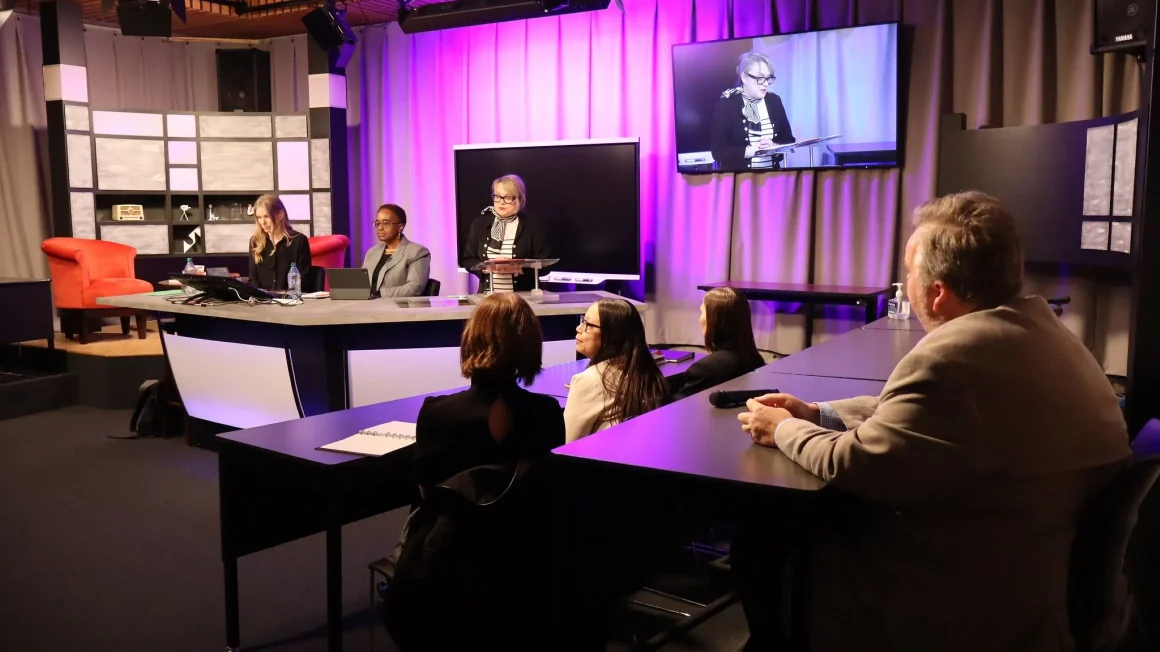
The first panel, Dialogue and Debate in the Age of Polarization, was held on April 14 at the UWinnipeg campus.
The panel featured Dr. Sheila Cote-Meek, Interim Vice-Provost, Indigenous Engagement at Brock University, Dr. Lilach Marom, Assistant Professor in the Faculty of Education at Simon Fraser University, and Dr. Malinda Smith, Associate Vice-President, Research-EDI, at the University of Calgary.
Leading experts in their fields, the panelists discussed the evolving role of universities in an increasingly polarized and polarizing social and political landscape. The panel explored the need to engage critically and respectfully across differences and work toward shared goals to transform universities and society for the better.
About the panelists
Dr. Sheila Cote-Meek is Anishinaabe from the Teme-Augama Anishnabai. She is currently Interim Vice-Provost, Indigenous Engagement at Brock University. She was the inaugural Vice-President, Equity, People and Culture at York University where she led the development of the Decolonizing, Equity, Diversity and Inclusion (DEDI) strategy and York’s Black Inclusion Strategy. She was the inaugural Associate-Vice-President, Indigenous and Academic Programs at Laurentian University where she also led key initiatives. Dr. Cote-Meek is author of Colonized Classrooms – Racism, Trauma and Resistance in Post-Secondary Education (2014) and three co-edited books: Decolonizing and Indigenizing Education in Canada (2020), Critical Reflections and Politics on Advancing Women in the Academy (2020) and Perspectives on Indigenous Pedagogy in Education: Learning from One Another (2023).
Dr. Lilach Marom is an Assistant Professor in the Faculty of Education at Simon Fraser University. She has worked as an educator with diverse students and communities across multiple national and institutional contexts. Her research draws on critical theories to examine issues of equity, anti-racism, and inclusion in education. Her scholarship addresses the experiences of racialized, Indigenous, disabled, and internationally educated teachers and students in higher and teacher education, with particular attention to the structural conditions shaping professional recognition and inclusion.
Her current research examines EDI policies, discourses, and action plans in Canadian higher education, asking what is included and what is left unaddressed in pursuit of a more robust understanding and implementation of EDI. Her recent project focused on Jewish identity and antisemitism in Canadian higher education, exploring how Jewish faculty and staff navigate institutional spaces within current campus environments. She recently received a SSHRC Insight Grant to extend these questions into the K-12 system. Her research has appeared in multiple publications and has been supported by SSHRC and external funding.
Dr. Malinda S. Smith is an Associate Vice-President (Research) and Full Professor of Political Science at the University of Calgary, where she serves on the Senior Leadership Team and advances inclusive research excellence across the institution and nationally. She co-led the Presidential Task Force on Equity, Diversity, Inclusion and Accessibility, chairs the Dimensions EDI team, and leads the CFREF One Child Every Child Equitable Pathways Accelerator and Council.
Her current research examines inclusive leadership and social justice in higher education. Across eight collaborative books, she has helped shape debates on fairness and equity in Canadian universities, African and diaspora studies, and public policy. She is co-author of The Equity Myth: Racialization and Indigeneity at Canadian Universities and co-editor of Nuances of Blackness in the Canadian Academy. Her edited and co-edited volumes, including Globalizing Africa, Securing Africa, States of Race, and Critical Concepts, extend these debates.
Dr. Smith has published in Policy Options, University Affairs, University World News, The Globe and Mail, The Calgary Herald, and The Hill Times, and has reached broader audiences through CBC Ideas and The Fifth Estate. Her public scholarship examines contested questions in higher education, including viewpoint diversity, ‘anti-woke’ politics, epistemic pluralism, and the human rights foundations of inclusive societies. Her concept of the pluralism dividend advances how diversity and inclusion both underwrite excellence, and generate measurable returns across research, institutional governance, and democratic renewal.
Nationally, Dr. Smith serves on the Social Sciences and Humanities Research Council of Canada, Statistics Canada’s Immigration and Ethnocultural Statistics Advisory Committee, and the Innovation, Science and Economic Development Canada’s External EDI Advisory Board. She is Vice-Chair of the Scarborough Charter Steering Committee. As a former Vice President (Equity Issues) she Chaired the Federation for the Humanities and Social Sciences’ Advisory Committee that developed the “Igniting Change” Report on Equity, Diversity, Inclusion, and Decolonization.
Dr. Smith’s contributions have been recognized with the 2025 Distinguished Alumni Award from the University of Alberta, a Doctor of Laws (honoris causa) from Simon Fraser University, the ISA–Canada Distinguished Scholar Award, and a Pierre Elliott Trudeau Foundation Fellowship.