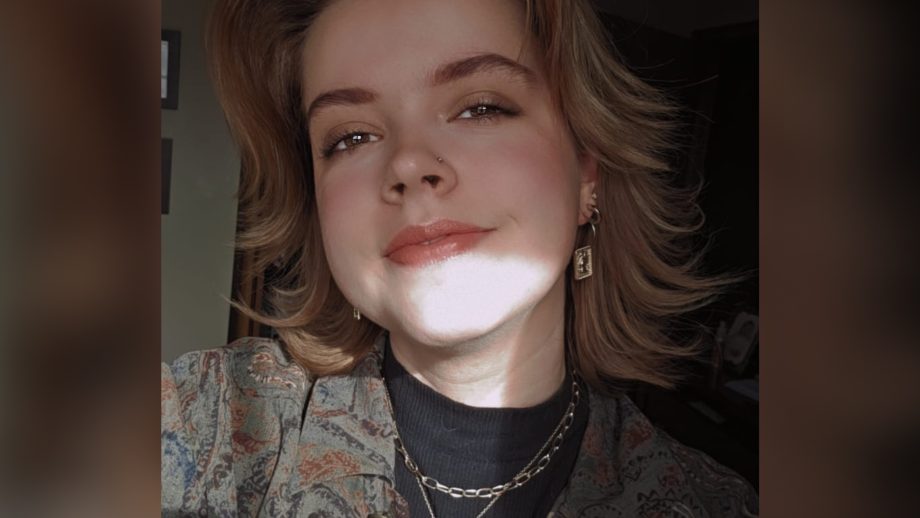
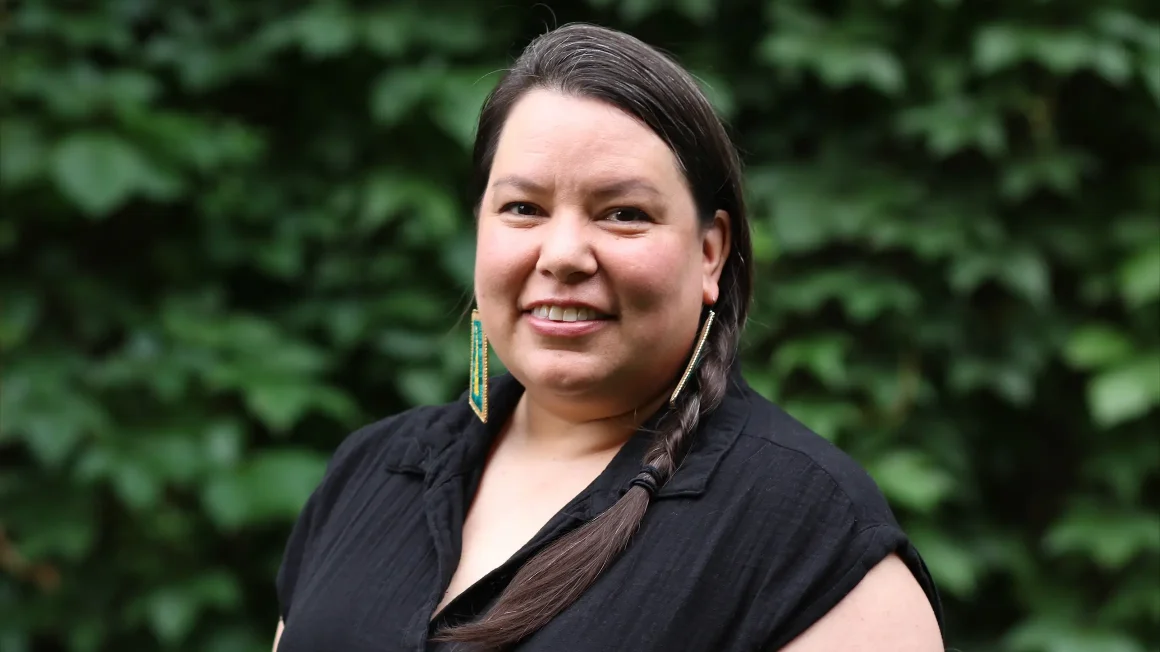
When it comes to storytelling, the written word hasn’t always been a first choice for Minawaanigogizhigok, who is also known as Dawnis Kennedy.
Through her work in the Anishinaabe community, she has more often been an orator, singer, and a collector of stories. Through her work as a scholar and associate professor in UWinnipeg’s Department of Criminal Justice, writing mostly for her research pursuits or out of an administrative need.
But when her fictional short story was one of 30 chosen out of nearly 3,000 submissions to be on the longlist for the CBC Short Story Prize, she thought of herself for the first time as a writer.
“Writing is kind of like my side gig,” Kennedy said. “I’d write these little things all the time to just like decompress and just express myself more fully. And now that I could work them up into something that’s valuable to other people, I think that’s wonderful. That’s part of healing. And that’s part of countering colonization too.”
This work that I’m doing, and this voice that I’m finding, is a contribution beyond me that’s important to more than just me.
Dawnis Kennedy
Kennedy said she was shy about submitting her story to the contest, but also feels it’s important to see Indigenous people doing things on a national scale and being celebrated.
“I think everybody kind of goes through like, ‘am I good enough?’ or this idea of imposter syndrome,” she said. “But then you layer on top the targeting that’s levelled at Indigenous people, Indigenous women, and Indigenous academics. You have to put yourself out against barriers, to stand against that colonial belief that we as Indigenous people, our cultures, our languages, our laws, our ways of seeing the world, aren’t valuable. That they need to be erased or that they’re inferior.”
Kennedy’s short story, nindikwewimin: we are women, speaks to the role women take on as caregivers in society.
“It’s seen as undervalued care work and it’s not seen as governance,” she said. “It’s not seen as law. It’s not seen as valuable. It’s something that you do in your home life or your personal life. It’s not a professional asset. But really, this is the way that the world works. By these connections and by these relationships, and centering relationships and connection as opposed to individuality.”
Kennedy’s hopes her short story will be published as part of a bigger collection of stories that center the gifts women bring to the world, the cost or toll this work takes on them, but also the wealth that comes along when women have time to honour their intuition and “time to care for our hearts”.
“I feel like we all feel like we’re hanging on by the skin of our teeth trying to do so much,” she said. “We need that stability. And that’s not going to come from exploitation or working harder.”
For Kennedy, there is no distinction between what is personal life, what is community life, and what is professional life.
“To me, there’s just Mino-Bimaadziwin. There’s good life,” she said. “We’re trying to do our work in a good way. And in a full way. And that includes our families, that includes our communities, and everybody should be able to center that.”
Kennedy said writing the short story itself was an exercise in balancing her research work, teaching classes, supporting important Indigenous program development and policy change at UWinnipeg, while still giving herself “permission to play”.
“I’m excited. It validates that time that I carve out, because I’m behind on so many things,” she laughed. “I made this investment in me and what I thought was valuable. This work that I’m doing, and this voice that I’m finding, is a contribution beyond me that’s important to more than just me.”