Scientists will soon have access to brand new, vital information about Lake Winnipeg.
“It’s a new frontier,” said Dr. Emily Chase, “so everything that we find will be meaningful.”
Dr. Chase is a professor in UWinnipeg’s Department of Biology and is the first person to ever study algal viruses in Lake Winnipeg, work that will contribute to building more accurate climate change models for the lake.
“It feels exciting. Not necessarily because I’m the first, but because it’s such a big question mark,” she said. “There are so many little stories for me to unravel with my trainees, and I’m really excited to see them do that.”
It’s a new frontier, so everything that we find will be meaningful.
Dr. Emily Chase
Dr. Chase is a microbiologist and virologist who joined UWinnipeg in 2025, bringing with her years of experience in the study of micro-algal aquatic viruses. As part of a small community of international scientists working in this field, she has conducted research in Nova Scotia, France and the United States, and has worked on lake data from across the globe.
“There’s very few people in the world working on this stuff,” she said. “That was one of the reasons I was so excited to come to UWinnipeg. To bring those skills, do something that I think is meaningful, and also pass those skills on to students at UWinnipeg.”
With funding from a Natural Sciences and Engineering Research Council of Canada grant, Dr. Chase is looking at dynamics between the microalgae and the viruses in Lake Winnipeg.
“A lot of times people see microalgae as plants, just because they look like a bunch of scum on the water and they are quite green,” she explained.
Microalgae are actually single-celled organisms that are susceptible to viruses in the same way humans are. Although the viruses that infect microalgae don’t pose a threat to human health, they do impact the health of the lake ecosystem.
“It’s under the bigger umbrella of climate change,” Dr. Chase explained. “Understanding the ecology between these microbes will give us more information on what will happen with fish stocks, what will happen with tourism, and what will happen with the health of the lake overall.”
“It’s the same kind of health perspective for humans,” she added. “If we don’t understand the viruses that are infecting us, how can we predict what might happen next flu season or what a pandemic’s impacts might be.”
Not only is Dr. Chase conducting pioneering research in Lake Winnipeg, she is also carving out a path as one of the few women working in her field.
“It’s been beneficial for me to be a bit stubborn and opinionated and outspoken,” she said. “And I hope me laying the groundwork and being somebody like this, people after me won’t have to do that as much.”
“Science is about curiosity and troubleshooting and exploration,” she added. “Anytime that we have people coming in who have different perspectives, whether that’s women, BIPOC, or otherwise, you end up branching out that curiosity much further.”
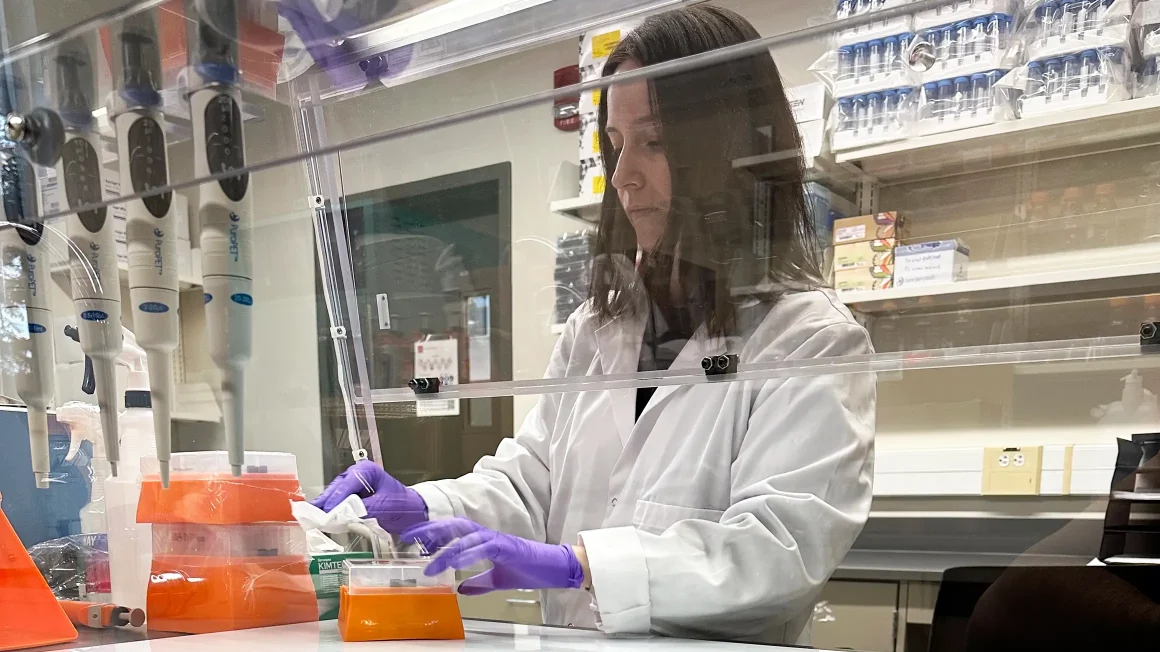
Over the past year Dr. Chase and her team have been collecting and analyzing water samples from across Lake Winnipeg. Although the research is in its early stages, she hopes to be able to share some results in the near future. She also hopes those results will contribute to a greater understanding of microalgal viruses worldwide.
“Even though I’m the first at Lake Winnipeg,” Dr. Chase said, “by understanding our lake system it can help us understand other lake systems too.”
February 11 is the International Day of Women and Girls in Science. To recognize this day, UWinnipeg is honoured to highlight research like Dr. Chase’s, that makes outstanding contributions to scientific research at the university and in the community.