A federally-funded qualitative research project undertaken by an associate professor in UWinnipeg’s Faculty of Education will examine feelings around climate change among middle-schoolers in Winnipeg, and identify ways schools can channel those difficult feelings into positive collective action.
Last summer, Dr. Brenton Button’s research project, “Fostering Climate Resilience in a School: A Pilot Study Using a Comprehensive Health Model” received a two-year, $64,601 Insight Development Grant from SSHRC, the Social Sciences and Humanities Research Council of Canada. Dr. Button was one of 12 UWinnipeg researchers who received a total of $688,135 through the 2025 announcement.
This approach emphasizes student voice and school empowerment.
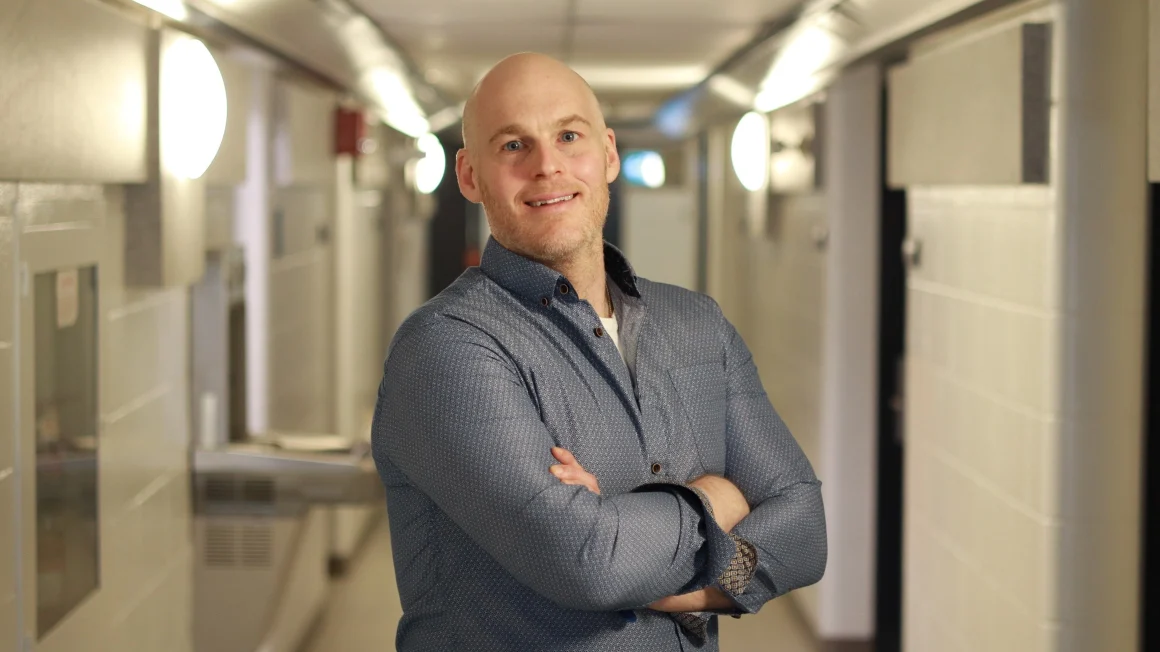
Dr. Brenton Button
“My academic interests revolve around how the school environment can contribute to children’s health,” said Dr. Button, who is also a researcher with the Children’s Hospital Research Institute of Manitoba.
A former schoolteacher with a background in public health, Dr. Button thinks about climate change from not only from an environmental perspective, but also through the lens of children’s emotional and psychological well-being.
Originally from Nipigon, Ont., he arrived at UWinnipeg in 2021 after completing postdoctoral work at the Northern Ontario School of Medicine.
An outdoor enthusiast, Dr. Button initially expected to become a health and phys-ed teacher. A decade ago, he began researching how things like weather and a school’s built environment affect children’s activity levels.
An ‘open-ended opportunity’
Children today feel climate change, Dr. Button explained. Those feelings can take the form of dread, worry, or a generalized concern about the future.
“They may not even have a term for it yet, but they do have emotions related to how the climate is changing,” he said.
For some children, last summer’s Manitoba wildfires made climate change hit home. The ripple effects were felt at school, as field trips cancellations and indoor recess became more common.
Dr. Button’s research project will span the length of the school year. This September, he and a research associate will spend two weeks in a Winnipeg school asking Grade 5 and 6 students to express their thoughts and feelings about climate change through art.
The students will create an artwork, such as a poster or comic strip, and respond to a set of open-ended, reflective questions about climate change. The goal is to get students to explain their thoughts and feelings in their own words and pictures, without the constraints of a survey.
It can be hard for researchers to ask the right questions about big, nebulous topics like climate change in a closed format like a survey, Dr. Button said. Drawing pictures is one way to encourage students to express thoughts and feelings that are hard to describe.
“When we give them open-ended opportunity, they have more freedom,” Dr. Button said. “We really want to hear their voices.”
Dr. Button chose Grade 5 and 6 students because they articulate enough to express complicated feelings, and are also an age when children are aware of climate change in their daily lives.
The September responses will provide an attitudinal baseline to measure against later in the school year. Next, Dr. Button will meet with teachers and principals to discuss what climate change actions they want to implement at the school, such as specialized lesson planning, extra-curricular clubs, or community partnerships.
These initiatives will be informed by a model known as Comprehensive School Health (CSH), a whole-school approach to improving student health and well-being. CSH includes four interconnected pillars: the social and physical environment, teaching and learning, school policy, and partnerships and services.
The strength of CSH lies in how these pillars work together, aligning programming and messaging, Dr. Button said.
“It’s about trying to get the entire school united and rallying around one aspect that they can get behind and support,” he explained. “It puts everybody on the same page, which can have a bigger impact.”
The school leads the charge, with Dr. Button playing a supporting role.
“This approach is not about the researcher telling schools what to do,” Dr. Button said. “Instead, it emphasizes student voice and school empowerment—allowing each community to determine what feels meaningful and relevant. The interconnectedness of these efforts across the school environment may create deeper and more lasting impact.”
At the end of the school year, the same students will again create an artwork and respond to a set of reflective questions.
“We will then compare the pre- and post-data to explore whether there are shifts in students’ emotions, perspectives, or sense of agency related to climate change,” Dr. Button said.
April 22 is Earth Day! This year’s theme is Our Power, Our Planet. Be part of the UWinnipeg team participating in the Downtown BIZ Spring CleanUp on Thursday, May 7. This is a great opportunity for students, faculty, and staff to get outside and support the local community through collective action. The first 100 registrants will receive a free UWinnipeg Spring CleanUp t-shirt! Sign up now.