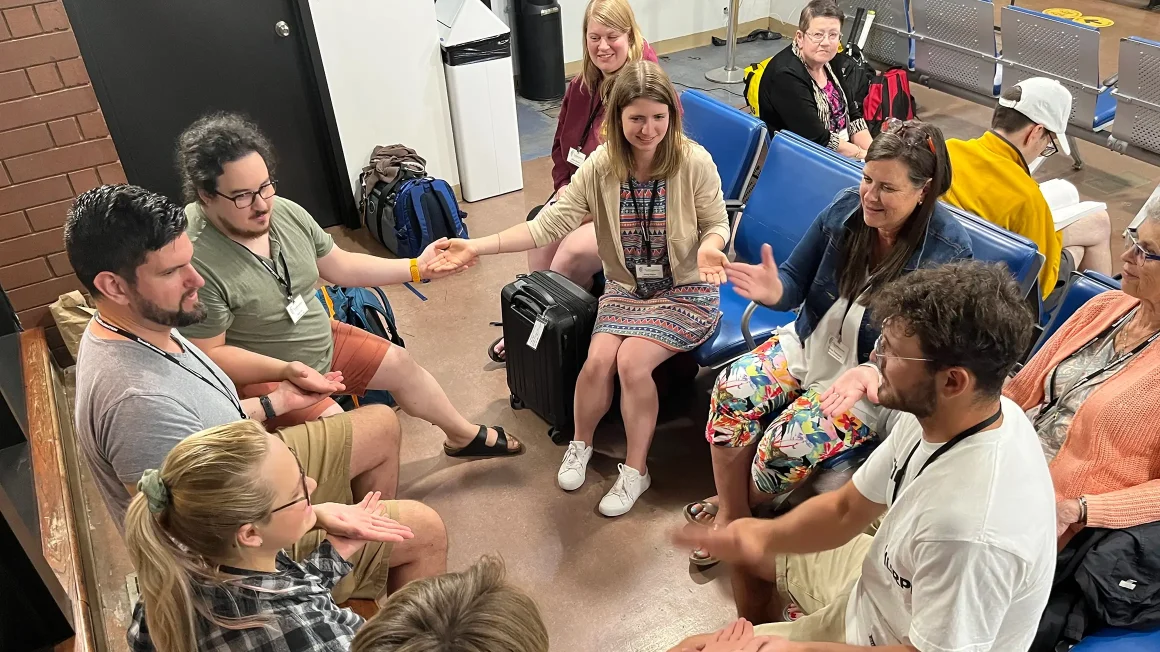
A collaborative new documentary follows UWinnipeg students and others who participated in a commemorative 100th anniversary immigration reenactment.
“Sometimes you’ll put up a statue or a plaque to commemorate, but to actually undertake a reenactment was very unique,” said UWinnipeg associate history professor Dr. Aileen Friesen. “From that standpoint, it seemed like maybe we should record this journey.”
The documentary, The Russlaender Migration: From Revolution to Reflection, takes viewers on a train journey from Quebec to British Columbia to memorialize a similar journey that took place one hundred years earlier, when nearly 21,000 Mennonites immigrated from the Soviet Union to come to Canada in the 1920s.
In 2023, the Mennonite Historical Society of Canada organized the reenactment, which UWinnipeg grad Theo Loewen (BA 25, BED 25) described as a “combination of history, travelling, and learning”.
I think the students really were excited for this experiential learning to take place, where they could interact with historians on board.
Dr. Aileen Friesen
“As a Mennonite and self-proclaimed Mennonite nerd, this opportunity had me excited just from the mention of it,” Loewen said.
Loewen was one of several UWinnipeg students who were sponsored to travel on the third leg of the train journey and participate in several educational events along the way.
Thousands of people attended events at several stops along the reenactment journey, including a singing festival that was held at the Centennial Concert Hall and a two-day conference held at the University of Winnipeg.
“I think the students really were excited for this experiential learning to take place, where they could interact with historians on board,” Dr. Friesen explained. “They could interact with other people who are undertaking the journey, who had their own family stories that were linked to this immigration movement.”
Working with Mennonite historical societies in Quebec, Ontario, Manitoba, Saskatchewan, Alberta, and British Columbia, UWinnipeg’s Centre for Transnational Mennonite Studies helped bring an academic perspective to the reenactment.
“A meaningful aspect of university life that sometimes gets overlooked is that we are actually involved in the community,” said Dr. Friesen. “We are taking our research and we’re bringing it directly into the community to help tell those stories and to help facilitate conversation about history.”
“For me personally, this was a journey that my grandparents both took,” Dr. Friesen added. “It is personal, but it is also a history that I study. So, I was able to integrate both the personal with broader themes. Immigration policy, settler colonialism, all of these themes are explored in this documentary, that in previous renditions of Mennonite history might have been pushed to the side, or just not acknowledged at all.”
Both the reenactment and the documentary provide examples of how we can find new ways to tell histories that better represent what actually took place.
“On one hand, we can’t forget our own histories of who we are, where we came from, and what that meant to our ancestors,” Dr. Friesen said. “On the other hand, we can’t ignore the other side of it, that our arrival was linked to Canada’s colonial project, which had repercussions for Indigenous peoples.”
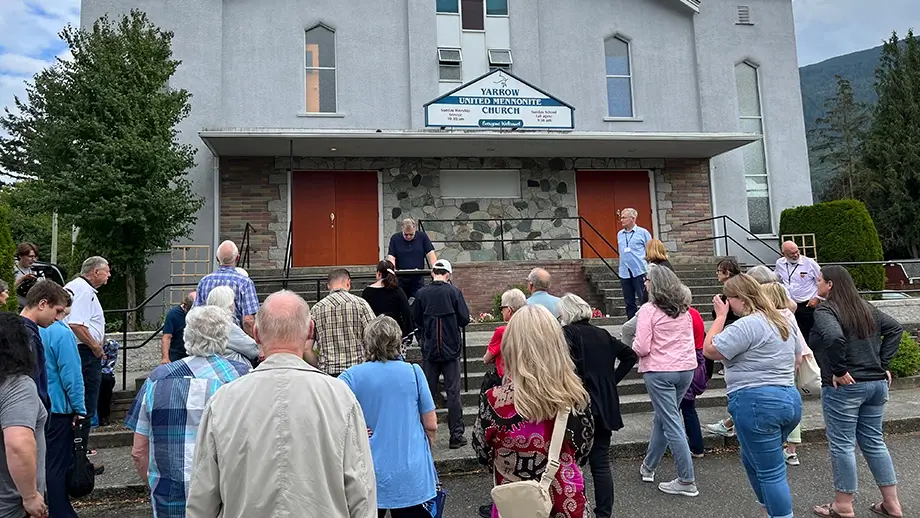
Participants visit Yarrow united Mennonite Church, one stop on the reenactment journey.
Loewen said he gained a lot of perspective from participating in the reenactment.
“I had no clue how hard it was for those who came in the 20s. My own great grandmother arrived after the Second World War having overcome and survived the First World War, Revolution, Holodomor, the Great Terror, and everything else imaginable.”
The journey allowed Loewen to visit a site where his great grandmother finally settled after years of fleeing hardships and war.
“It was a place where she could finally have peace and enjoy her last days in companionship,” Loewen explained. “My father has many fond stories of traveling to Yarrow to visit Oma, and I felt the peace and happiness there. We visited the cemetery, and many of us from across Canada visited past loved ones. That meant a lot to me.”
After several screening events across Canada, including one at UWinnipeg, The Russlaender Migration: From Revolution to Reflection is now available to view on YouTube.