A wellspring of local support has greeted a new distance-education program for aspiring public school teachers created through a unique partnership between UWinnipeg Access Education, Portage Community Revitalization Corporation, and Portage la Prairie School Division.
In January, 26 registered students ranging in age from 18 to 63 began a combination of in-person and online classes in Portage la Prairie with the goal becoming certified teachers in Manitoba.
Kirk Dowson, Manager of Access Education Programs at UWinnipeg, said many of the students are already working full-time, either in the school system as educational assistants, or in other professions. Some are internationally certified teachers seeking Manitoba certification.
“The vast majority of them are adults with families and jobs who want a change of career, so they fit nicely within Access Education, which was developed to take down barriers,” Dowson said.
The program offers two streams: an integrated five-year BA-BEd option, and a two-year after-degree option for those with an undergraduate degree. Classes are held during evenings and weekends to accommodate the students’ workweek commitments.
Integral to the success of the program are local supports provided by Portage la Prairie School Division (PLPSD) and Portage Community Revitalization Corporation (PCRC).
PLPSD is providing after-hours access to a high school library where students can meet up, study together, and livestream online courses, relieving some of the isolation that can accompany distance learning.
“Right from our earliest conversations, UWinnipeg demonstrated a willingness to think creatively and help us develop a meaningful, locally grown program,” said Rochelle Rands, Assistant Superintendent of PLPSD. “It is exciting to consider that in the next five to seven years, a new group of graduates—trained right here in the community—will be ready to bring their enthusiasm, innovative ideas, and love for this area directly into our rural classrooms.”
PCRC, meanwhile, has organized two popular information sessions and offers students support with everything from tutoring services to student loan application assistance.
“We’ve been very happy with our partnership with UWinnipeg,” said Mari Kozar, Executive Director of PCRC. “Everyone has been wonderful to work with and really got the program going much faster than we anticipated. This is definitely filling a gap.”
Addressing two challenges
The program is immediately meeting a short-term need for local teacher training in Portage la Prairie and the surrounding area. Educators and education students alike often face long commutes or a relocation, both of which are costly.
“I spoke to a current student who said she spends $1,100 per month on gasoline for her Honda Civic,” Dowson said.
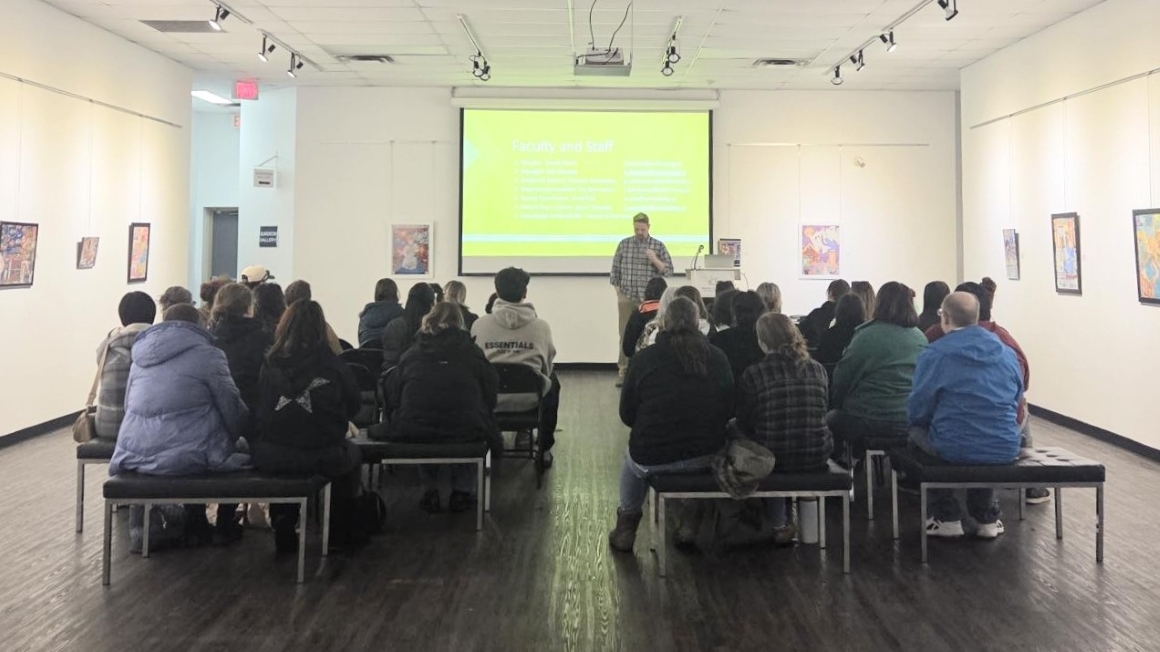
The first community information session, held at the Portage la Prairie Regional Library last October, proved just how much the community was looking for a local option.
“We set up in a room that holds 30 people, and 105 showed up,” Dowson said. “There was a huge lineup stretching out the door. It was mind-blowing. We ended up getting close to 50 applications to start in January.”

Over 100 people attended the first information session in October. Photo courtesy of PortageOnline.com.
“We actually didn’t have enough room for everyone so Kirk stood in a doorway presenting to two rooms of people,” Kozar recalled with a smile.
A second information session on February 5, for those wanting to start in September, attracted another 40 people. Applications to that intake closed March 1.
“It’s been a big signal to us that this is a really important thing we’re doing, and that there are a lot of communities out there that aren’t being served to meet their post-secondary needs,” Dowson said. “I think this is a growth area for us, serving these rural populations.”
In the long run, the hope is that by identifying teacher candidates who are from the community, and training them in the community, they’re more likely to stay and teach in the community. That could help reduce a chronic teacher shortage in PLPSD and surrounding school divisions.
Rands said it’s particularly challenging for PLPSD to recruit French immersion teachers, speech-language pathologists, and specialist teachers. To manage, the division relies on retired teachers willing to accept term positions, and on uncertified substitute teachers for day-to-day absences. The division also takes proactive steps, like posting positions early in the school year, attending recruitment fairs, and co-hosting a career fair. PLPSD also recently partnered with UWinnipeg’s Faculty of Education to establish a local post-baccalaureate diploma in inclusive education designed to help current staff upgrade their skills.
Access Education typically serves adult learners who are 21 years or older, but Dowson said students as young as 18 are expressing interest in the PLP teacher training program.
Kozar noted more students are working while studying because the overall cost of living has risen due to inflation. That has meant fewer students able to study full-time without also working.
“This program has really taken a lot of those burdens off,” Kozar said, “especially for anybody who might need to keep working while they take more training.”
Email accesseducation@uwinnipeg.ca for more information on the Portage la Prairie distance-education program.