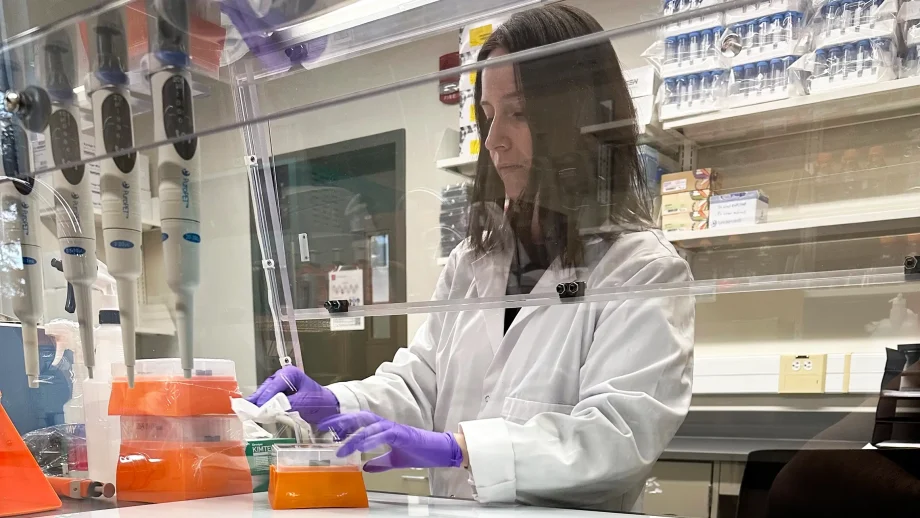

An evolutionary geneticist at the University of Winnipeg has published breakthrough research on fruit flies in a leading journal.
Dr. Alberto Civetta, Professor in the Department of Biology, published “Gene age shapes functional and evolutionary properties of the Drosophila seminal fluid proteome” in October in PNAS (Proceedings of the National Academy of Sciences).
The paper constitutes a major step forward in evolutionary sciences and genetics by revealing that the evolutionary age of genes influences gene function, gene interactions, and how fast genes change over time.
We should be paying more attention to the evolutionary age of genes.
Dr. Alberto Civetta
These findings overturn the common belief that the majority of reproductive genes are evolutionarily ‘young,’ showing instead that most are ancient.
Humans share many genes with fruit flies, making them a popular object of study in genetics research. Numerous Nobel Prizes have been awarded for discoveries made using fruit flies, including the genetic control of early embryonic development, the molecular basis of olfaction, mechanisms of innate immunity, and, most recently, the genes underlying circadian rhythms, which were first characterized in fruit flies (Drosophila).
“Flies have been a model in genetics for a long, long time, from the beginning of the 1900s,” Dr. Civetta said. “They’re easy to breed, and there are toolkits at our disposal that other species don’t have.”
Dr. Civetta’s current research on fruit flies is connected to a five-year, $245,000 NSERC Discovery Grant announced last summer. He said it feels good to publish in a highly-read journal like PNAS.
“I always try to go for journals that have more tradition and visibility,” he said. “There’s been very good reception so far.”
Dr. Civetta has been teaching and researching at UWinnipeg for 25 years. In 2020, he received the Erica and Arnold Rogers Award for Excellence in Research and Scholarship.
His research team, which includes a post-doctoral fellow and several undergraduate students, focuses on the evolutionary genetics of reproductive traits, especially genes that govern reproduction, including how and why they change among species.
About the paper
The paper focuses on a set of male reproductive genes that make the seminal fluid proteins (SFPs) that males transfer to females during mating. These proteins are of particular interest because they trigger a wide range of physiological and behavioral changes in females.
Dr. Civetta’s earlier research showed that male reproductive genes, including SFP genes, change faster than other genes. That insight has since been validated across different taxonomic groups and has led to the established notion that most SFPs are relatively new additions to the genome.
A few years ago, Dr. Civetta began looking at whole sets of SFPs, including the age of the gene, and found many of these proteins—up to 60 per cent—are actually quite old, evolutionarily speaking.
“This goes against the status quo thinking, which is that these genes have rapid turnover,” Dr. Civetta said. “In fact, only a small subset is evolutionarily young, form a tight network of interactions, and carry out highly specialized reproductive roles.”
Dr. Civetta himself was surprised by the proportion of genes that were evolutionarily old.
“What this tells us is that in reality, a lot of the molecular machinery needed for reproductive functions of the fruit fly…was there already. It’s been around for a long time, maybe being repurposed for different species in different ways.”
Dr. Civetta said the finding shows that new patterns in biology emerge only when gene evolutionary history is considered.
“We should be paying more attention to the evolutionary age of genes,” he said.
Dr. Civetta is now at work on a follow-up paper exploring the implications of these findings for human genetics and evolution.