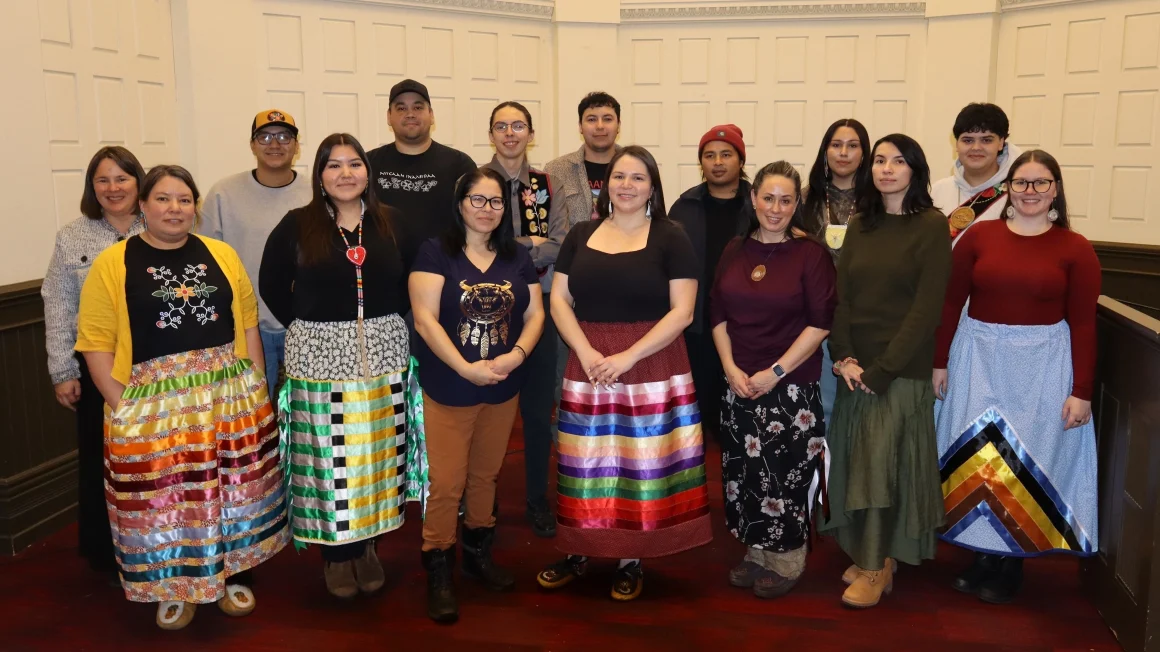
The University of Winnipeg’s new Anishinaabemowin Language Immersion Program began in ceremony on January 5, as the first 17 students, supported in community by Elders, faculty, and staff, gathered in Convocation Hall.
A feast and sharing time followed the ceremony, which was led by Elders and included pipe, prayer, drum, and song.
Elder Don Jones (pipe and prayer ceremony) led by sounding the eagle whistle to the four directions and brought teachings of aginjibagwesi, keeper of the language. He shared teachings and directions that will continue to guide the program and its participants.
This moment is the result of inter-generational efforts.
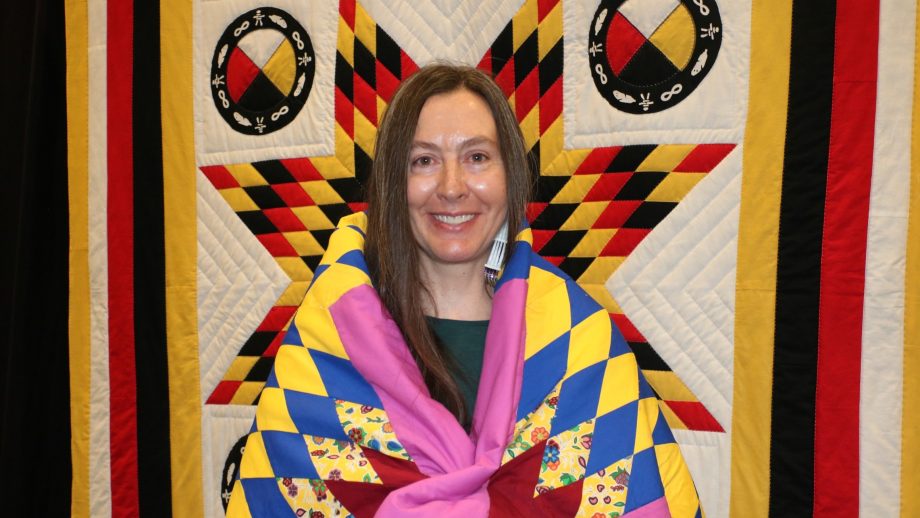
Dr. Chantal Fiola
Minweyweywigaan Lodge Chief Kirby Nelson (water drum carrier) lifted spirits, accompanied by other members of the lodge.
Grandmother Sherry Copenace (water ceremony) and Elder Harry Bone from the Treaty Relations Commission of Manitoba’s Council of Elders shared wisdom and guidance with students. Grandmother Copenace spoke of all the beings that bring life to creatures and creation.
Dr. Annie Boulanger is teaching one of the program’s main courses this term. In 2019, Dr. Boulanger received an Honorary Doctor of Laws from UWinnipeg for her longstanding commitment to Indigenous language preservation and revitalization. She spoke to students and guests, sharing the belief that has guided her decades of teaching: that everything we need is in the language, teachings, protocols, for mino-bimaadiziwin (the good life).
Elder Harry Bone (prayer) spoke for the food and shared lessons he learned from his grandmother. He spoke of the importance of Indigenous languages for sovereignty, noting that a language carries within it a worldview, and emphasized the importance of drawing strength (mashkawigaabawi, or standing strong) from one’s origins.
“You have to know where you came from to know where you are going,” he said.
Elder Don Jones shared about being taken to residential school and how he missed so much of the traditional education he wanted. He stressed the importance of learning on the land and from elders, and explained how, as an adult, he was able to learn from his father and from elders by listening.
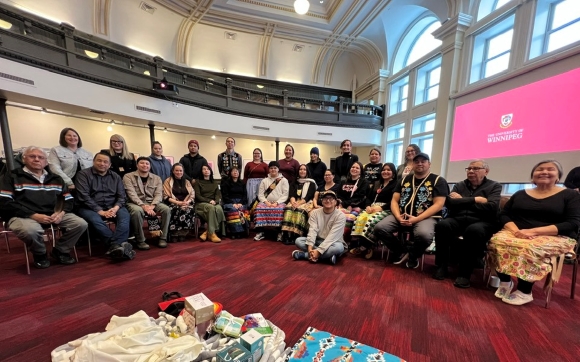
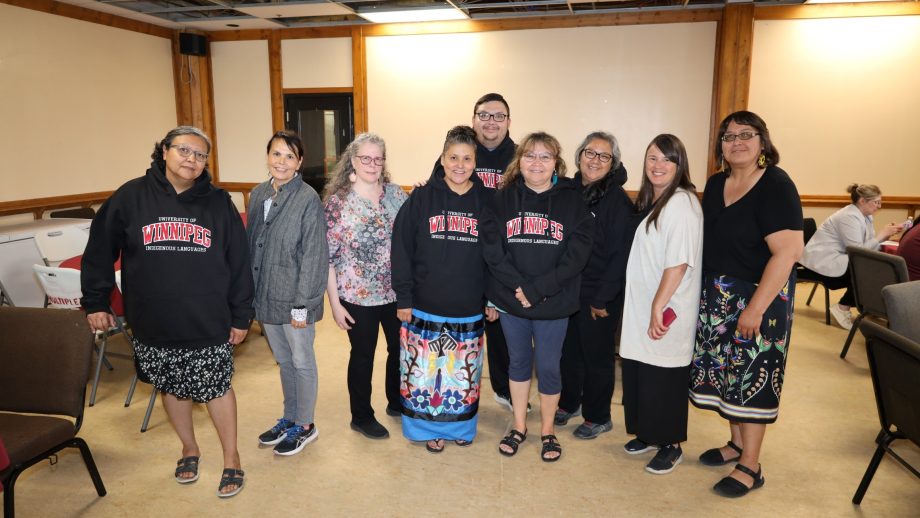
Elders, leaders, faculty, and staff supported the students with a ceremony and feast in Convocation Hall.
The students, who began their studies the following day, come from across Manitoba and beyond, united by their passion for learning Anishinaabemowin (Ojibwe, Saulteaux language).
They will learn Anishinaabemowin together for about 15 hours per week (six credit hours per term), year-round. Introductory, intermediate, and advanced courses will be supplemented with a mentor-apprentice program, immersion field schools, and engagements with the wider Anishinaabe-speaking community over shared meals and at special events.
The courses are fully accredited and may be used towards a Certificate or a Bachelor of Arts degree in Indigenous Languages. The program was created last fall with $2.3 million from the Province of Manitoba. It is Manitoba’s first immersion degree program for Anishinaabemowin second-language learners.
In addition to developing fluent speakers, the program will also provide a pathway to teacher certification, thereby helping to fill immersion teaching positions across Manitoba.
‘Historic moment’
Dr. Chantal Fiola, Associate Vice-President, Indigenous Engagement, said the launch of this crucial program “marks a historic moment in time.”
“Despite the insidious legacy of colonization, Anishinaabemowin language speakers and learners have done what is needed to protect the language,” Dr. Fiola said. “This moment is the result of inter-generational efforts; many people have put their hands to this important work to get us to where we are now. There is much good work ahead—I express my gratitude to everyone for their ongoing collaborative efforts.”
“This important work reflects what is possible when people come together with care, commitment, and a shared sense of purpose,” said Dr. Pavlina Radia, Provost and Vice-President, Academic. “I want to sincerely thank the faculty, staff, Elders, and partners whose leadership and persistence helped bring this proposal forward. Their efforts have created a strong foundation for advancing Indigenous language vitality and learning at UWinnipeg in the years ahead.”
Dr. Jino Distasio, Interim President and Vice-Chancellor of UWinnipeg, extended “a big, heartfelt thank-you” to everyone who worked together to make the program a reality. He said he looked forward seeing the positive impact its graduates will make in the coming years.
Renée Cable, Manitoba Minister of Advanced Education and Training, was also in attendance.
“I hope that folks take a moment to soak in the magnitude of this,” she said, calling the program a “monumental” addition to the University’s offerings. She also commended the students for learning a new language in adulthood.
“Thank you for being brave in the face of tremendous adversity, and doing something that is pretty radical. Just know that you make all of us so, so proud,” she said.
Building fluency, building connections
Prof. Aandeg Muldrew, Assistant Professor of Anthropology and Coordinator of the Anishinaabemowin Language Immersion Program, said the program serves as a pathway for students to build their fluency in Anishinaabemowin in the classroom, with each other, and with other language speakers. They will also learn outside of the classroom, in community and land-based learning contexts.
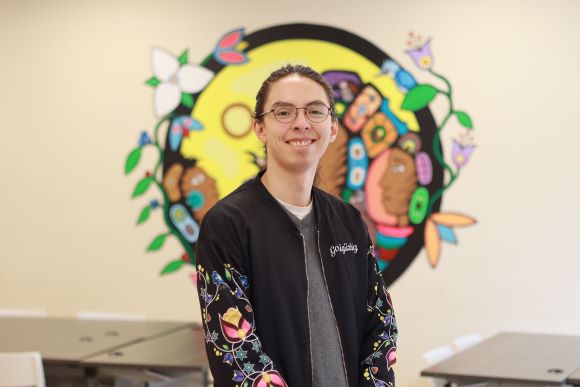
Prof. Aandeg Muldrew, Program Coordinator.
During the morning ceremony, Prof. Muldrew encouraged learners by recounting his long language-learning journey. He knows firsthand how transformational language learning can be. Born and raised in Winnipeg’s inner-city, he is a member of Lac Seul First Nation in northern Ontario who learned Anishinaabemowin from his gookom, who is a well-known Anishinaabemowin educator.
“I didn’t start out speaking it as a kid,” Prof. Muldrew said. “I attribute my learning to her classes and immersion camps with fluent speakers.”
For more information on the Anishinaabemowin Language Immersion Program, visit the Indigenous Languages website.