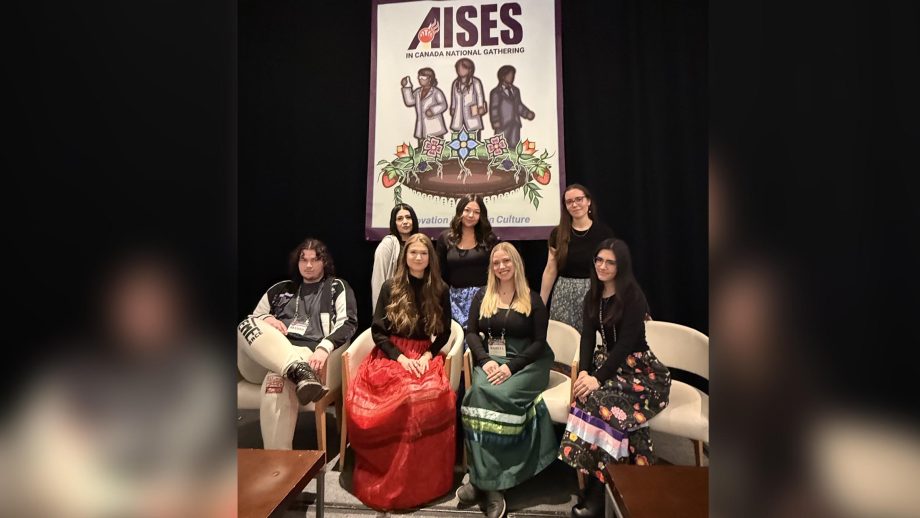


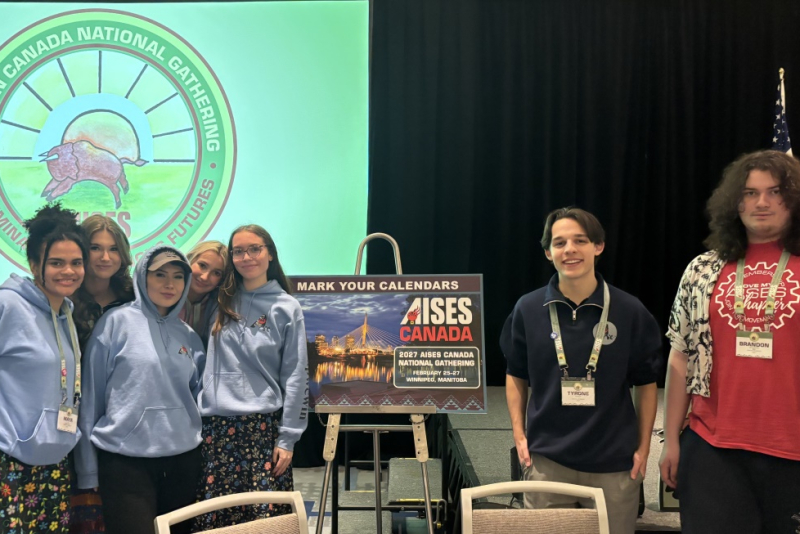

Nine University of Winnipeg students have returned from a whirlwind trip to the 2026 AISES in Canada National Gathering in Toronto March 5–7.
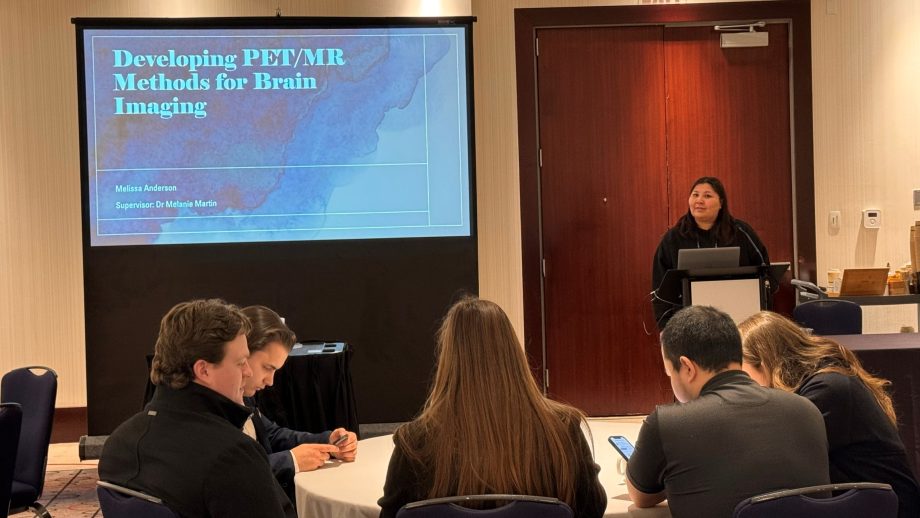
Abby Alexander, Brandon Wittmeier, Denielle Peron, Flora Easter, Leena Tetrault, Maya Tighe, Paige Gordon, Tyrone Reimer, and Logan Asham attended the National Gathering, which this year carried the theme, “Illuminating Indigenous Futures.” Many of the students also presented original research.
AISES in Canada is a non-profit organization focused on increasing Indigenous representation in STEM (science, technology, engineering, and math) studies and careers. It supports both undergraduate and graduate students through programs, scholarships, and events, culminating each year in a National Gathering where students and professionals from across Canada create long-lasting connections.
UWinnipeg is home to one of 11 post-secondary chapters of .caISES, the Canadian Indigenous Science and Engineering Society. The group meets monthly to take part in cultural activities and community events, attend leadership summits, and participate in conferences. UWinnipeg’s .caISES chapter is especially active, winning awards in 2020 and 2022.
UWinnipeg students won’t have to travel far next year. Conference organizers announced that Winnipeg will host the 2027 AISES in Canada National Gathering February 25–27.
Making connections, sharing research
It was Maya Tighe’s first time attending a National Gathering.
“I wanted the opportunity to learn about Indigenous students and their research projects,” said Tighe, a graduate student in her first year of the Master of Science in Bioscience, Technology and Public Policy program. “It seemed like a good chance to meet like-minded students and make connections that I would otherwise not have known about.”
By bringing together students and professionals, National Gatherings give students a glimpse of future career opportunities.
The environment is so positive and welcoming, and it’s amazing to connect with and learn from other Indigenous scholars.
Leena Tetrault
“My favourite part was going around to the booths and speaking with all the industry people, learning about their stories and experiences,” Tighe said. “Seeing how these companies are supporting Indigenous students was enlightening.”
Abby Alexander, a fourth-year Indigenous Studies major, was attending her third National Gathering.
“It’s a great opportunity for student researchers to present, learn about other research projects, and connect with community, which is so important for us as Indigenous people,” Alexander said.
She especially enjoyed the feeling of being immersed in a community stretching across Canada and the United States.
“Each person at this gathering has such knowledge and expertise that any conversation is so eye-opening and allows you to learn so much,” said Alexander, who presented on medicinal and food plants in boreal forests. She undertook the research as part of the Six Seasons of the Asiniskaw Īthiniwak project.
Leena Tetrault, a fourth-year Biochemistry student, attended last year’s National Gathering and knew she wanted to go again.
“The environment is so positive and welcoming, and it’s amazing to connect with and learn from other Indigenous scholars,” she said.
Tetrault presented research on parasites in aquatic snails.
“It was such an amazing experience,” she said. “I emphasized how Western science lacks lots of ethical consideration for research on invertebrates, and that using Indigenous knowledges and worldviews can help us conduct this research in a more respectful and reciprocal way. Other scholars told me after my presentation how much they enjoyed the talk and appreciated what I had shared.”
Denielle Peron, a third-year Psychology major from Pine Creek First Nation, brought her passion for Indigenous women’s healthcare to her first National Gathering. She encountered valuable research from Saskatchewan that compared ER wait times for Indigenous people and non-Indigenous people.
“I also wanted to explore my career opportunities and network with other students, which led to meeting amazing new friends,” Peron said.
One researcher Peron met at the conference expressed interest in collaborating on future work, and is interested using her research in their master’s thesis.
Peron presented a literature review on the relationships between trauma-related disorders and POTS (Postural Orthostatic Tachycardia Syndrome).
“I discussed hormonal similarities between PTSD and POTS and how further research should be conducted to determine if there is a correlation between the development of POTS after getting PTSD,” Peron said.
The students also squeezed in some fun on the trip, visiting the Eaton Centre, CN Tower, Ripley’s Aquarium, Union Station, the Hockey Hall of Fame, and even Niagara Falls, as well as local coffeeshops and bookstores.
The students received travel support from UWinnipeg Foundation donor Ken Rosenberg, the UWinnipeg Research Office, Research Manitoba, and Guidewire.